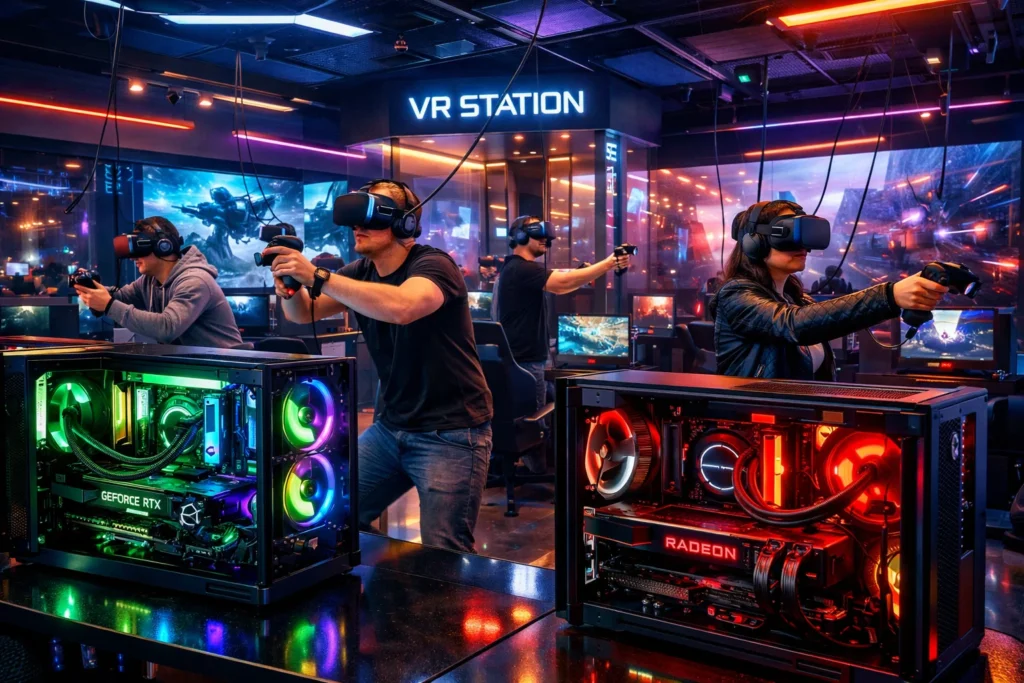

Virtual reality has transformed the gaming landscape, offering players an immersive experience that feels lifelike and interactive. In gaming lounges and cyber cafés, the demand for VR gaming setups is increasing rapidly as players look for new ways to experience games beyond traditional screens. However, achieving a smooth, high-performance VR experience depends heavily on one key component: the graphics card. Understanding the right graphics card requirements for VR zones in gaming and cyber cafés is essential for business owners who want to offer premium gaming experiences without technical issues or performance drops.
The Importance of Choosing the Right Graphics Card for VR Gaming
Unlike standard PC gaming, virtual reality requires your system to process two simultaneous images, one for each eye, at very high frame rates. This means the graphics card has to render scenes at double the rate while maintaining high visual quality to prevent lag, frame drops, or motion sickness.
A powerful graphics card ensures that the VR headset delivers smooth visuals, accurate motion tracking, and a truly immersive environment. Without a strong GPU, even the most advanced VR headset can underperform, leading to stuttering or discomfort during gameplay. For gaming café owners, investing in high-quality GPUs directly translates to satisfied customers and a stronger reputation for top-tier gaming experiences.
Understanding VR Graphics Card Performance Needs
To run VR titles effectively, systems must meet or exceed the minimum hardware requirements set by headset manufacturers like Meta, HTC, or Valve. These headsets, such as the Meta Quest 3, HTC Vive Pro 2, or Valve Index, require powerful GPUs to render high-resolution visuals at refresh rates between 90 and 144 Hz.
Typically, VR-ready PCs require:
-
NVIDIA GeForce RTX 3060 or higher
-
AMD Radeon RX 6700 XT or higher
-
A CPU with at least 6 cores (Intel i5/i7 or AMD Ryzen 5/7)
-
Minimum 16 GB RAM
The graphics card, however, remains the backbone of the system. For smooth gameplay, café owners should target GPUs that deliver consistent frame rates above 90 FPS in VR environments.
Recommended Graphics Cards for VR Zones
Choosing the right GPU depends on the balance between performance, cost, and longevity. Gaming cafés require systems that can handle a wide range of VR games, from casual rhythm titles to intense action simulations.
1. NVIDIA GeForce RTX 4070 and RTX 4080
These GPUs offer excellent performance for demanding VR titles and can easily support popular headsets. The RTX 4070 is ideal for mid-range setups, while the RTX 4080 caters to premium VR stations with ultra-smooth rendering and real-time ray tracing.
2. AMD Radeon RX 7900 XT
AMD’s RX 7900 XT provides outstanding power and great value for businesses setting up multiple systems. Its large memory capacity and efficient architecture make it a reliable choice for VR cafés focusing on long-term performance.
3. NVIDIA GeForce RTX 3060 Ti
For budget-conscious setups, the RTX 3060 Ti remains a capable GPU that can run most VR games smoothly. It’s suitable for entry-level VR zones that want solid performance without overspending.
Balancing Cost and Performance for Cyber Café Owners
When managing a gaming café, maintaining a balance between cost efficiency and gaming quality is crucial. Installing the latest high-end graphics cards in every system might not always be practical, especially if you are equipping 20 or more machines. Instead, segmenting your café into performance tiers can help.
For example, you can dedicate a few premium VR stations powered by RTX 4080s or RX 7900 XTs for advanced games, while other stations use mid-range GPUs like the RTX 4070 or 3060 Ti. This gives customers flexible pricing options and helps you manage your budget more effectively.
If you plan to upgrade multiple PCs at once, it’s smart to buy graphics cards in bulk, which often comes with discounts or wholesale pricing from suppliers. This approach helps standardize performance across machines and reduces compatibility issues.
Why Graphics Cards Are Crucial for Customer Satisfaction
In VR gaming, the experience is everything. Players expect smooth visuals, realistic motion, and zero latency. The graphics card directly affects each of these elements. A weak GPU can cause motion blur or lag, which not only ruins immersion but can also cause nausea or eye strain.
For cyber cafés, this could mean negative reviews or decreased foot traffic. On the other hand, powerful GPUs ensure that every gaming session feels seamless. Whether it’s exploring detailed fantasy worlds or engaging in competitive VR sports, the graphics card plays the most vital role in delivering an unforgettable gaming experience.
Cooling and Maintenance for Optimal GPU Performance
High-performance graphics cards produce significant heat, especially during extended VR sessions. In a café environment, where systems often run all day, overheating can lead to throttling or hardware damage.
To avoid this, ensure that every PC has proper airflow and cooling solutions. Using GPUs with efficient cooling systems, such as dual or triple fans, helps maintain consistent performance. Regular maintenance, including cleaning dust filters and checking thermal paste, also extends GPU lifespan and keeps performance steady.
Additionally, installing monitoring software like MSI Afterburner or AMD Adrenalin can help café managers track GPU temperatures and usage in real time. Preventive measures reduce downtime and protect your investment in expensive hardware.
Power Supply and Compatibility Considerations
Even the most powerful graphics card won’t perform properly if your power supply unit (PSU) can’t deliver adequate power. Each GPU has its own wattage requirements, so choosing the right PSU is essential.
For example, an RTX 4070 may require a 650W PSU, while an RTX 4080 may need 750W or more. Using a high-quality, 80 Plus Gold-certified PSU ensures stable performance and minimizes the risk of power fluctuations that can damage components.
When setting up multiple systems, standardizing power supplies and motherboards simplifies maintenance and ensures consistent compatibility across all VR stations.
Software Optimization and Driver Updates
To maximize your graphics card’s potential, always keep GPU drivers updated. Manufacturers like NVIDIA and AMD frequently release driver updates optimized for the latest games and VR software. Outdated drivers can lead to performance drops, visual glitches, or even crashes during gameplay.
Additionally, optimizing in-game settings according to your GPU’s capabilities ensures smooth operation. For VR cafés, using consistent software configurations across all systems prevents customer complaints and minimizes troubleshooting time.
Preparing for Future VR Developments
VR technology continues to evolve rapidly. Upcoming titles and headsets will demand even higher graphical fidelity and faster performance. Investing in modern, future-ready GPUs helps your café stay competitive for years to come.
Graphics cards like the RTX 4080 or RX 7900 XT offer support for advanced features such as ray tracing, DLSS, and AI-powered rendering, which will become increasingly important in next-generation VR experiences. Future-proofing your setup not only enhances customer satisfaction but also saves long-term upgrade costs.
Conclusion
Building a successful VR zone in a gaming or cyber café requires more than just VR headsets and stylish décor; it starts with choosing the right graphics card. The GPU determines how immersive, smooth, and visually appealing the VR experience will be. Investing in the right hardware, maintaining cooling systems, and ensuring software optimization are key steps toward offering an exceptional VR experience that keeps gamers coming back.
Whether you’re setting up a small gaming lounge or a full-scale VR café, understanding your graphics card requirements and planning your hardware investment wisely will set your business apart. With the right strategy, you’ll deliver cutting-edge virtual reality entertainment that captivates players and positions your café as a leader in the gaming community.