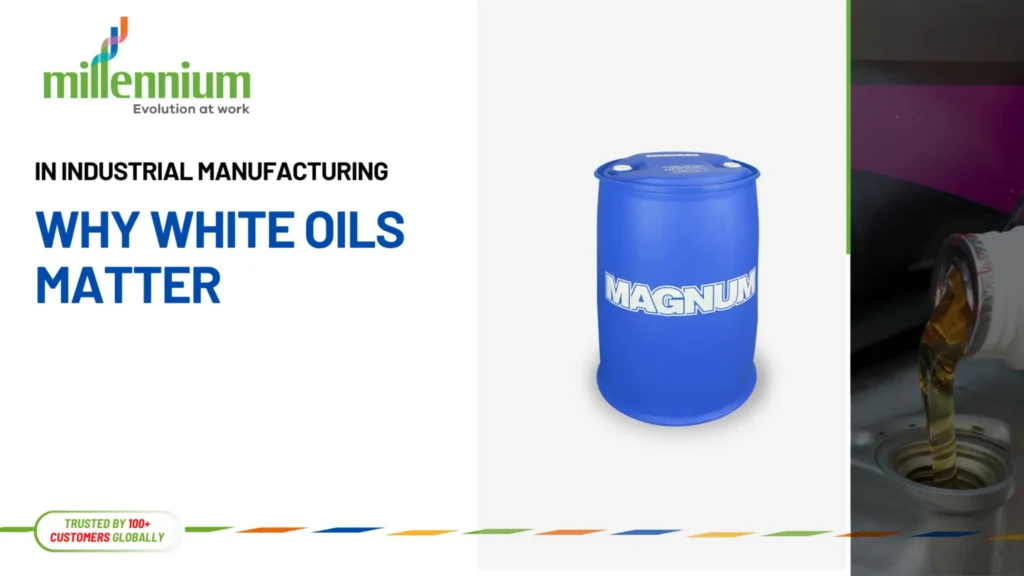

In modern industrial manufacturing, every material used in production must meet strict expectations for consistency, safety, and performance. Among these materials, white mineral oils play a vital yet often overlooked role. Although frequently associated with cosmetic or pharmaceutical products, white oils are equally important in non-cosmetic industrial applications, where purity, neutrality, and reliability directly affect product quality and process efficiency. Their unique properties make them a trusted choice across multiple manufacturing sectors.
What Exactly Is White Mineral Oil?
White mineral oil is a highly refined petroleum oil produced through advanced purification processes such as hydrogenation and distillation. These processes remove impurities like aromatics, sulfur compounds, and reactive hydrocarbons, resulting in an oil that is colorless, odorless, and chemically stable.
What sets white mineral oil apart from conventional industrial oils is its exceptional purity and inert behavior. It does not easily react with plastics, rubber, fibers, or chemicals, making it ideal for applications where material interaction must be carefully controlled. Different viscosity grades allow manufacturers to choose the right oil for lubrication, processing, or formulation needs.
Real-World Applications (Non-Cosmetic, All Business)
White oils are widely used in industrial environments where cleanliness, consistency, and process control are essential.
1. Plastics & Polymers
In plastics and polymer manufacturing, white oils act as processing aids and flow improvers. They help reduce internal friction during extrusion, injection molding, and compounding processes. This leads to smoother material flow, reduced equipment wear, and improved surface finish of final products.
Because white oils are colorless and stable, they are especially valuable in applications involving light-colored or transparent polymers. Their inert nature ensures that they do not interfere with polymer chemistry or compromise mechanical properties.
2. Adhesives & Sealants
White mineral oil applications are commonly used in adhesive and sealant formulations as carrier oils or viscosity modifiers. They contribute to uniform consistency, better spreadability, and controlled curing behavior.
In industrial bonding applications—such as packaging, construction, and assembly—white oils help maintain formulation stability over time. Their low volatility and oxidation resistance support longer shelf life and predictable performance during application.
3. Textile Manufacturing
Textile production involves high-speed processes that generate friction, static, and mechanical stress on fibers. White oils are used as fiber lubricants and spinning oils to reduce friction and prevent yarn breakage.
Their clean characteristics allow easy removal during washing or finishing stages, ensuring no unwanted residue remains on finished fabrics. White oils also help control static electricity, improving efficiency and fabric quality across weaving and knitting operations.
4. Rubber & Elastomers
In rubber and elastomer manufacturing, white oils serve as softeners and processing oils. They improve compound flexibility, enhance filler dispersion, and make rubber easier to mix and shape.
Compared to conventional aromatic oils, white oils offer better color stability and lower odor, making them suitable for applications where appearance and cleanliness matter. They are widely used in seals, gaskets, molded components, and technical rubber goods.
5. Food Packaging (Non-Contact Zones)
Within food packaging plants, white oils are used in non-food-contact applications, such as lubricating machinery, conveyors, and processing equipment. Their high purity reduces the risk of contamination, even in sensitive production environments.
Although not intended for direct food contact in this context, white oils provide a safer alternative to standard industrial lubricants, helping manufacturers meet hygiene and safety expectations.
6. Chemical & Agrochemical Formulations
White mineral oils play an important role in chemical and agrochemical manufacturing as diluents, carriers, or formulation components. Their chemical neutrality ensures compatibility with active ingredients and additives.
They help achieve consistent viscosity, stable blends, and uniform application characteristics. This reliability is crucial for maintaining product quality and performance across large-scale production batches.
Why MAGNUM’s White Oils Stand Out
MAGNUM’s White Oils are designed specifically for demanding industrial applications. Manufactured using advanced refining technologies, they deliver consistent quality and dependable performance across multiple sectors.
Key benefits include:
-
High purity with minimal impurities
-
Excellent thermal and oxidation stability
-
Neutral color and odor
-
Reliable viscosity control
These characteristics make MAGNUM’s white oils a preferred choice for manufacturers seeking process efficiency and product consistency.
Compliance, Safety & Standards
White oils used in industrial manufacturing are often produced in line with international safety and quality standards. Depending on the grade, they may meet requirements related to food packaging environments, occupational safety, and environmental responsibility.
Their refined composition helps reduce health risks and environmental impact compared to less processed oils. Proper certification and documentation further support their safe use in regulated industrial settings.
How to Use & Store It Right
Correct usage and storage are essential to maintain white oil quality and effectiveness.
Picking the Right Grade
-
Choose viscosity based on application requirements
-
Ensure compatibility with materials and processes
-
Select certified grades when compliance is required
Storage & Handling
-
Store in clean, sealed containers
-
Protect from moisture, dust, and extreme temperatures
-
Use dedicated equipment to avoid cross-contamination
-
Monitor oil clarity and condition regularly
Good handling practices preserve oil purity and extend service life.
Final Word
White mineral oils are a key enabler of efficiency and quality in industrial manufacturing. Their purity, stability, and versatility make them indispensable across plastics, adhesives, textiles, rubber, packaging, and chemical production. With reliable solutions like MAGNUM’s White Oils, manufacturers can optimize processes, maintain high product standards, and operate with confidence. In non-cosmetic industrial applications, white oils truly prove their value.